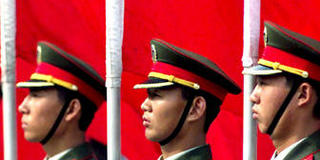
We'd better wake up before it's too late (if it isn't already). We need to stop importing Chinese goods--and thus exporting all of our money which pays for Chinese armaments--and quit talking about closing U.S. military bases. The so-called "peace dividend" everybody rah-rahed after the Cold War has turned into more bloated bureaucracy and a new arms race.
Chinese dragon awakens
http://www.washtimes.com/specialreport/20050626-122138-1088r.htm
By Bill Gertz
THE WASHINGTON TIMES
June 26, 2005
Part I
China is building its military forces faster than U.S. intelligence and military analysts expected, prompting fears that Beijing will attack Taiwan in the next two years, according to Pentagon officials.
U.S. defense and intelligence officials say all the signs point in one troubling direction: Beijing then will be forced to go to war with the United States, which has vowed to defend Taiwan against a Chinese attack.
China's military buildup includes an array of new high-technology weapons, such as warships, submarines, missiles and a maneuverable warhead designed to defeat U.S. missile defenses. Recent intelligence reports also show that China has stepped up military exercises involving amphibious assaults, viewed as another sign that it is preparing for an attack on Taiwan.
"There's a growing consensus that at some point in the mid-to-late '90s, there was a fundamental shift in the sophistication, breadth and re-sorting of Chinese defense planning," said Richard Lawless, a senior China-policy maker in the Pentagon. "And what we're seeing now is a manifestation of that change in the number of new systems that are being deployed, the sophistication of those systems and the interoperability of the systems."
China's economy has been growing at a rate of at least 10 percent for each of the past 10 years, providing the country's military with the needed funds for modernization.
The combination of a vibrant centralized economy, growing military and increasingly fervent nationalism has transformed China into what many defense officials view as a fascist state.
"We may be seeing in China the first true fascist society on the model of Nazi Germany, where you have this incredible resource base in a commercial economy with strong nationalism, which the military was able to reach into and ramp up incredible production," a senior defense official said.
For Pentagon officials, alarm bells have been going off for the past two years as China's military began rapidly building and buying new troop- and weapon-carrying ships and submarines.
The release of an official Chinese government report in December called the situation on the Taiwan Strait "grim" and said the country's military could "crush" Taiwan.
Earlier this year, Beijing passed an anti-secession law, a unilateral measure that upset the fragile political status quo across the Taiwan Strait. The law gives Chinese leaders a legal basis they previously did not have to conduct a military attack on Taiwan, U.S. officials said.
The war fears come despite the fact that China is hosting the Olympic Games in 2008 and, therefore, some officials say, would be reluctant to invoke the international condemnation that a military attack on Taiwan would cause.
Army of the future
In the past, some defense specialists insisted a Chinese attack on Taiwan would be a "million-man swim" across the Taiwan Strait because of the country's lack of troop-carrying ships.
"We left the million-man swim behind in about 1998, 1999," the senior Pentagon official said. "And in fact, what people are saying now, whether or not that construct was ever useful, is that it's a moot point, because in just amphibious lift alone, the Chinese are doubling or even quadrupling their capability on an annual basis."
Asked about a possible Chinese attack on Taiwan, the official put it bluntly: "In the '07-'08 time frame, a capability will be there that a year ago we would have said was very, very unlikely. We now assess that as being very likely to be there."
Air Force Gen. Paul V. Hester, head of the Pacific Air Forces, said the U.S. military has been watching China's military buildup but has found it difficult to penetrate Beijing's "veil" of secrecy over it.
While military modernization itself is not a major worry, "what does provide you a pause for interest and concern is the amount of modernization, the kind of modernization and the size of the modernization," he said during a recent breakfast meeting with reporters.
China is building capabilities such as aerial refueling and airborne warning and control aircraft that can be used for regional defense and long-range power projection, Gen. Hester said.
It also is developing a maneuverable re-entry vehicle, or MARV, for its nuclear warheads. The weapon is designed to counter U.S. strategic-missile defenses, according to officials who spoke on the condition of anonymity. The warhead would be used on China's new DF-31 long-range missiles and its new submarine missile, the JL-2.
Work being done on China's weapons and reconnaissance systems will give its military the capability to reach 1,000 miles into the sea, "which gives them the visibility on the movement of not only our airplanes in the air, but also our forces at sea," Gen. Hester said.
Beijing also has built a new tank for its large armed forces. It is known as the Type 99 and appears similar in design to Germany's Leopard 2 main battle tank. The tank is outfitted with new artillery, anti-aircraft and machine guns, advanced fire-control systems and improved engines.
The country's air power is growing through the purchase of new fighters from Russia, such as Su-30 fighter-bombers, as well as the development of its own fighter jets, such as the J-10.
Gen. Hester compared Chinese warplanes with those of the former Soviet Union, which were less capable than their U.S. counterparts, but still very deadly.
"They have great equipment. The fighters are very technologically advanced, and what we know about them gives us pause for concern against ours," he said.
Missiles also are a worry.
"It is their surface-to-air missiles, their [advanced] SAMs and their surface-to-surface missiles, and the precision, more importantly, of those surface-to-surface missiles that provide, obviously, the ability to pinpoint targets that we might have out in the region, or our friends and allies might have," Gen. Hester said.
The advances give the Chinese military "the ability ... to reach out and touch parts of the United States -- Guam, Hawaii and the mainland of the United States," he said.
To better deal with possible future conflicts in Asia, the Pentagon is modernizing U.S. military facilities on the Western Pacific island of Guam and planning to move more forces there.
The Air Force will regularly rotate Air Expeditionary Force units to Guam and also will station the new long-range unmanned aerial vehicle known as Global Hawk on the island, he said.
It also has stationed B-2 stealth bombers on Guam temporarily and is expected to deploy B-1 bombers there, in addition to the B-52s now deployed there, Gen. Hester said.
Projecting power
China's rulers have adopted what is known as the "two-island chain" strategy of extending control over large areas of the Pacific, covering inner and outer chains of islands stretching from Japan to Indonesia.
"Clearly, they are still influenced by this first and second island chain," the intelligence official said.
The official said China's buildup goes beyond what would be needed to fight a war against Taiwan.
The conclusion of this official is that China wants a "blue-water" navy capable of projecting power far beyond the two island chains.
"If you look at the technical capabilities of the weapons platforms that they're fielding, the sea-keeping capabilities, the size, sensors and weapons fit, this capability transcends the baseline that is required to deal with a Taiwan situation militarily," the intelligence official said.
"So they are positioned then, if [Taiwan is] resolved one way or the other, to really become a regional military power as well."
The dispatch of a Han-class submarine late last year to waters near Guam, Taiwan and Japan was an indication of the Chinese military's drive to expand its oceangoing capabilities, the officials said. The submarine surfaced in Japanese waters, triggering an emergency deployment of Japan's naval forces.
Beijing later issued an apology for the incursion, but the political damage was done. Within months, Japan began adopting a tougher political posture toward China in its defense policies and public statements. A recent Japanese government defense report called China a strategic national security concern. It was the first time China was named specifically in a Japanese defense report.
Energy supply a factor
For China, Taiwan is not the only issue behind the buildup of military forces. Beijing also is facing a major energy shortage that, according to one Pentagon study, could lead it to use military force to seize territory with oil and gas resources.
The report produced for the Office of Net Assessment, which conducts assessments of future threats, was made public in January and warned that China's need for oil, gas and other energy resources is driving the country toward becoming an expansionist power.
China "is looking not only to build a blue-water navy to control the sea lanes [from the Middle East], but also to develop undersea mines and missile capabilities to deter the potential disruption of its energy supplies from potential threats, including the U.S. Navy, especially in the case of a conflict with Taiwan," the report said.
The report said China believes the United States already controls the sea routes from the oil-rich Persian Gulf through the Malacca Strait. Chinese President Hu Jintao has called this strategic vulnerability to disrupted energy supplies Beijing's "Malacca Dilemma."
To prevent any disruption, China has adopted a "string of pearls" strategy that calls for both offensive and defensive measures stretching along the oil-shipment sea lanes from China's coast to the Middle East.
The "pearls" include the Chinese-financed seaport being built at Gwadar, on the coast of western Pakistan, and commercial and military efforts to establish bases or diplomatic ties in Bangladesh, Burma, Cambodia, Thailand and disputed islands in the South China Sea.
The report stated that China's ability to use these pearls for a "credible" military action is not certain.
Pentagon intelligence officials, however, say the rapid Chinese naval buildup includes the capability to project power to these sea lanes in the future.
"They are not doing a lot of surface patrols or any other kind of security evolutions that far afield," the intelligence official said. "There's no evidence of [Chinese military basing there] yet, but we do need to keep an eye toward that expansion."
The report also highlighted the vulnerability of China's oil and gas infrastructure to a crippling U.S. attack.
"The U.S. military could severely cripple Chinese resistance [during a conflict over Taiwan] by blocking its energy supply, whereas the [People's Liberation Army navy] poses little threat to United States' energy security," it said.
China views the United States as "a potential threat because of its military superiority, its willingness to disrupt China's energy imports, its perceived encirclement of China and its disposition toward manipulating international politics," the report said.
'Mercantilist measures'
The report stated that China will resort "to extreme, offensive and mercantilist measures when other strategies fail, to mitigate its vulnerabilities, such as seizing control of energy resources in neighboring states."
U.S. officials have said two likely targets for China are the Russian Far East, which has vast oil and gas deposits, and Southeast Asia, which also has oil and gas resources.
Michael Pillsbury, a former Pentagon official and specialist on China's military, said the internal U.S. government debate on the issue and excessive Chinese secrecy about its military buildup "has cost us 10 years to figure out what to do"
"Everybody is starting to acknowledge the hard facts," Mr. Pillsbury said. "The China military buildup has been accelerating since 1999. As the buildup has gotten worse, China is trying hard to mask it."
Richard Fisher, vice president of the International Assessment and Strategy Center, said that in 10 years, the Chinese army has shifted from a defensive force to an advanced military soon capable of operations ranging from space warfare to global non-nuclear cruise-missile strikes.
"Let's all wake up. The post-Cold War peace is over," Mr. Fisher said. "We are now in an arms race with a new superpower whose goal is to contain and overtake the United States."